


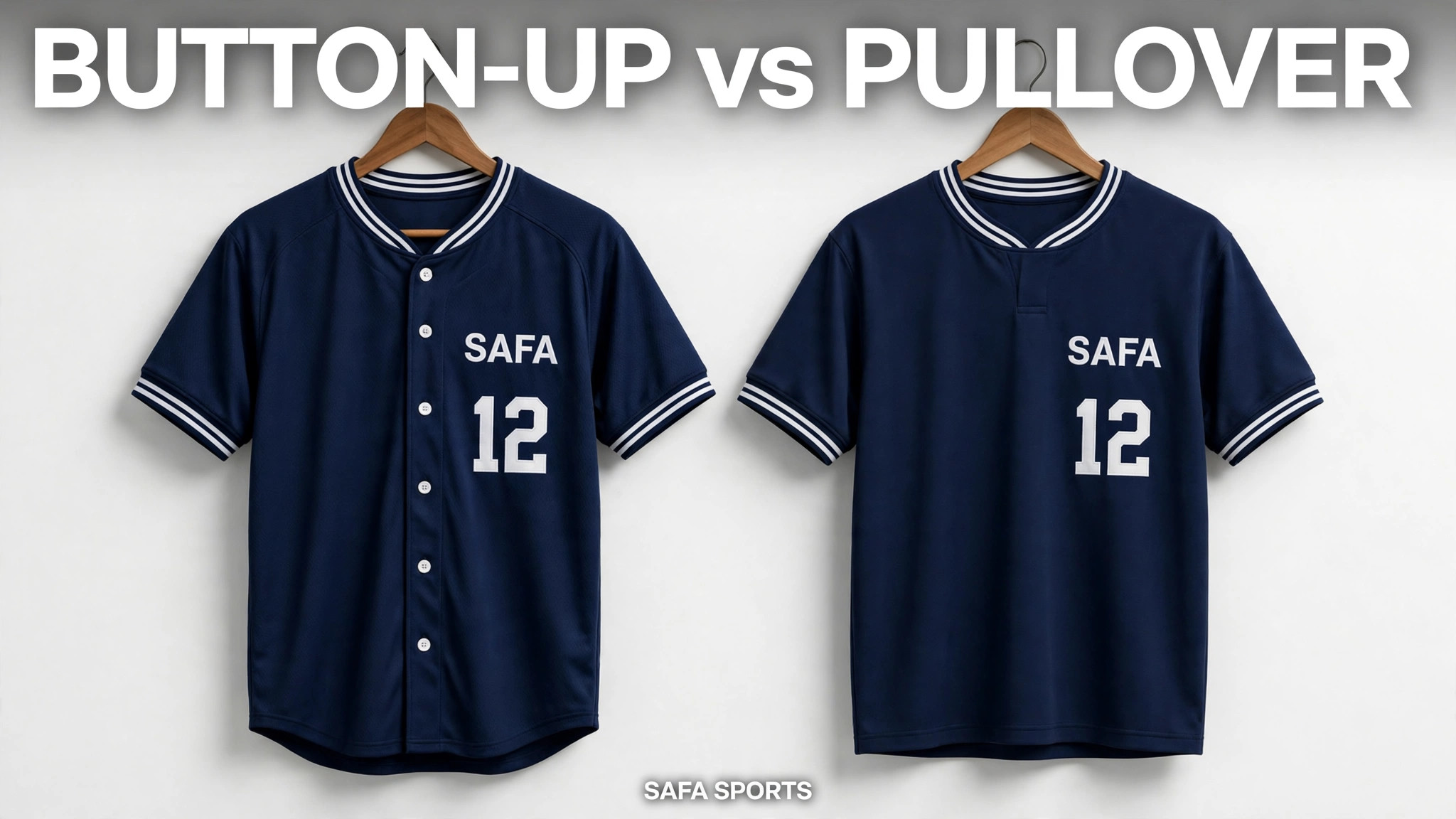
Button-Up vs Pullover Baseball Jerseys: Which Style Is Right for Your Team? (2026)
Ask ten coaches which baseball jersey style is best and you will get ten confident answers — and most of them will be right, for their team. The jersey cut is not a fashion choice. It changes how a player moves, how hot he feels in July, how easy the jersey is to take off over gear, and where the team name and numbers can sit. Pick the wrong cut and the team spends a season fighting a small annoyance on every play. Pick the right one and nobody thinks about the jersey at all, which is exactly the point.
This guide compares the four cuts a team will actually be offered — full-button, two-button, V-neck pullover and crew-neck pullover — and shows which one suits youth teams, adult teams, pitchers, catchers and outfielders, in hot weather and in cool weather. It builds on our guide to how to design a baseball uniform, so if you have already picked your colours and logo, this is the next decision to make.
The direct answer
For most teams, the full-button jersey is the safe default: the classic look, the easiest to take on and off, and the best in hot weather. The pullover is the practical choice for youth and travel teams: lighter, with nothing to lose or break, and simpler to wear. The two-button sits in between, and the choice between V-neck and crew-neck pullover is mostly about the look and the fit around the neck. Decide by age group first, then by position and climate — and order the same cut for the whole team.
SAFA SPORTS (PVT) LTD, a custom team uniform manufacturer since 2007, builds every style with a free design mockup before you pay and a minimum order of only 10 pieces, shipping to the USA. The mockup shows your exact cut with your colours and numbers on it, so you can see the decision before you commit to it.
The four cuts, in plain terms
Before comparing them, it helps to picture each one clearly, because the names are used loosely and suppliers do not always mean the same thing by them.
| Cut | What it looks like | The front |
|---|---|---|
| Full-button | Buttons all the way down the front, the classic baseball look | Open front, team name split across the two sides |
| Two-button | Buttons only at the top, a cleaner front | Mostly closed front, team name in one piece |
| V-neck pullover | No buttons, pulled over the head, V-shaped neck | One unbroken front, the biggest space for a logo |
| Crew-neck pullover | No buttons, pulled over the head, round neck | One unbroken front, the simplest look of all |
The full-button and two-button are both “button” jerseys, and the V-neck and crew-neck are both pullovers — the neck shape is the difference between the two pullovers, not a different category. When you send your design brief, name the cut and the neck shape together, for example “full-button” or “V-neck pullover”, so there is no room for misunderstanding at the mockup stage.
Full-button: the classic, and the easiest to live with
The full-button jersey is the one most people picture when they think of baseball. It buttons all the way down the front, and that open front is its biggest practical advantage. A player can take it off without pulling it over his head, which matters more than it sounds: a catcher coming off the field in full gear, a pitcher between innings, a player with a sore shoulder — all of them can get a button jersey off without a struggle. It is also the easiest jersey to ventilate. Unbutton the top two buttons on a hot day and the air moves; a pullover offers no such option.
The team name sits across the chest in two halves, split by the button line. That split is worth thinking about when you design the logo: a long team name can look broken across the opening, so short names and arched lettering work best on a full-button. Our design guide covers where the logo goes on each style, and the free mockup will show you whether your name reads cleanly across the buttons before you approve anything.
The downsides are small but real. Buttons are parts, and parts can be lost — a popped button mid-season is a minor repair, not a disaster, but it is one more thing to fix. And a full-button jersey usually costs more to make than a pullover, because there is more work in it: the button placket, the buttons themselves, the extra stitching. Our guide to how much custom baseball uniforms cost in 2026 explains what drives the price, and the cut is one of those factors — worth knowing before you ask for a quote, not after.
Two-button: the modern middle ground
The two-button jersey keeps the classic feel with a cleaner front. Only the top of the jersey buttons, so the team name sits in one unbroken piece across the chest, while the player still gets some of the ventilation and easy removal of a button jersey. It is the style teams pick when they want to look traditional in photographs but modern on the field, and it suits a long team name better than the full-button does, because nothing splits the lettering.
It is a good compromise, and compromises have compromise-sized downsides: you cannot open it as far as a full-button on a hot day, and you cannot take it off as easily as a full-button either — it still has to come over the head, or be unbuttoned and wriggled out of. For most teams that is a fair trade. If your team likes the classic look but your name is long, the two-button is usually the answer.
Pullover: lighter, simpler, and the youth-team favourite
A pullover has no buttons at all. It goes on over the head, and that simplicity is its whole case. There is nothing to lose, nothing to break, and nothing to catch on a glove or a fence. It is lighter than a button jersey, because there is no placket and no hardware, and it is usually the cheapest cut to make. For youth and travel teams, those three facts decide it: young players can dress themselves without help, parents are not sewing buttons back on, and a coach ordering for a growing roster is not paying for parts the players do not need.
The front is one unbroken panel, which gives the designer the most room to work with. A big chest logo, a full team name, a large front number — all of them fit on a pullover without a button line cutting through them. That is why pullovers suit bold, modern designs best, and why they are popular with travel teams that want a strong look.
The trade-offs are ventilation and removal. A pullover is harder to cool down in, because there is nothing to open, and it is harder to take off over shoulder pads or a sore arm. In a cool climate that hardly matters. In a hot climate, it matters a lot — a team playing summer ball in the heat should think twice before choosing a pullover for every player, and should at least consider it for the youngest age groups, who feel the heat less and lose buttons more.
V-neck or crew-neck? Mostly the look, partly the fit
Between the two pullovers, the choice is smaller than the choice between button and pullover, but it still deserves a decision rather than a shrug. The V-neck looks more like a baseball jersey: it opens the chest, it suits a team name arched across the front, and it feels cooler around the neck on a hot day. The crew-neck is plainer and more like a training top: it sits higher, it suits a smaller chest logo or a single letter, and some players find it more comfortable under a jacket or a warm-up top.
For youth teams, the V-neck is usually the better pick — it is easier to pull on and off, and it reads as a proper game jersey rather than a practice shirt. For adult teams that want a clean, modern look, the crew-neck works well, especially with a minimal design. Either way, say which one you want in the brief. “Pullover” on its own leaves the supplier guessing, and a guess at the mockup stage costs a round of corrections.
Which suits whom — age, position and climate
The cut should follow the players wearing it, not the coach’s taste alone. A short guide:
Youth teams. Pullover, usually V-neck. No buttons to lose, easy to put on without help, lightest to wear, and the unbroken front takes a big, bold team name that young players love. If the league plays in serious heat, consider the two-button instead, so players can open the top on hot days — but for most youth leagues, the pullover wins.
Adult and travel teams. Full-button or two-button. Adults can manage buttons, the classic look photographs well, and the ventilation matters over a long season. Travel teams that want a modern look often pick the two-button; teams that want the traditional look pick the full-button.
Pitchers. A pullover is fine, but a button jersey has one quiet advantage: a pitcher can open it between innings without disturbing his arm, and can take it off without pulling it over a warm shoulder. If your pitchers complain about their jersey, the cut is the first thing to check.
Catchers. Full-button, without much debate. A catcher takes his jersey on and off over chest gear more than any other player, and does it in a hurry between innings. A pullover over a chest protector is a wrestling match. If the team wears one cut and the catcher needs another, that is the one exception worth making — order the catchers’ jerseys in full-button and the rest of the team in the team’s cut.
Outfielders. Any cut works. Outfielders run the most and sweat the most, so weight and ventilation matter more than the front style — a light pullover in a cool climate, or a button jersey they can open in the heat.
Hot climates. Button jerseys, full or two-button, because they ventilate. A pullover in real heat is a decision the team will regret by the third inning of the second game of a double-header.
Cool climates. Any cut works, and the pullover’s warmth becomes an advantage rather than a drawback. A crew-neck pullover under a warm-up jacket is a comfortable combination for spring and autumn ball.
How the cut changes the design
The cut does not just change the jersey — it changes where the design can go. On a full-button, the chest logo is split, so keep the name short or arched, and put the big artwork on the back, where the number sits in one piece. On a two-button, the name sits whole across the chest, and the buttons at the top are small enough not to fight it. On a pullover, the whole front is yours: a big chest logo, a full name, a front number — everything fits, and the design can be bolder.
That is also why the cut and the decoration method should be decided together. Sublimation prints the design into the fabric and suits a pullover’s big unbroken front, because it can carry bold, multi-colour artwork without cracking. Embroidery stitches the design on and suits a button jersey’s smaller, simpler chest mark, because fine stitching reads better on a structured front. Our guide to sublimation vs embroidery for baseball uniforms compares the two in detail, and our fabric guide explains which fabric each method needs — sublimation only works on polyester, so the fabric choice and the cut choice are linked.
Numbers deserve the same thought. On a button jersey, the back number is the main number and the front number is optional. On a pullover, a front number is easy and looks natural, because there is nothing in the way. Either way, keep the numbers big and in the contrast colour, and check them on the mockup at the smallest size in your order — a design that reads well on an adult large can crowd a youth small, as our design guide explains.
The ordering checklist for jersey styles
Use this list when you send the brief, so the style decision is made once and made clearly:
- One cut for the whole team — full-button, two-button, V-neck pullover or crew-neck pullover, named in full.
- Catchers checked separately — full-button for catchers even if the team wears a pullover.
- Sizes per style — a pullover and a button jersey fit differently, so confirm sizes against the mockup, not against last season’s jerseys; see our sizing guide.
- Spare jerseys in the same style — a spare in a different cut from the rest of the team looks like a mistake in photographs; order spares in the team’s cut, as our guide to how to order custom baseball uniforms explains.
- Logo and numbers placed for the cut — short or arched name on a full-button, big unbroken artwork on a pullover.
- Decoration method matched — sublimation for bold pullover artwork, embroidery for a clean button-jersey mark.
- Mockup checked on the smallest and largest sizes — the design must read on both.
Frequently asked questions
Can I mix button-up and pullover jerseys in one order?
Yes, you can — and the one mix that makes sense is catchers in full-button while the rest of the team wears a pullover, because catchers take their jersey off over gear. Mixing the whole team, half button and half pullover, looks untidy in team photographs and confuses the size and design checks, so it is better to pick one cut for the team and make the catcher exception only where it is needed.
Which style lasts longer?
The pullover, slightly, because it has no buttons to lose and no placket to wear out. But the difference is small, and washing matters more than the cut — cold wash, inside out, air dry. Our guide to how to wash custom baseball uniforms covers the routine that keeps any style looking new all season, and a button jersey that is washed properly will outlast a pullover that is not.
Which style is better for youth leagues?
The pullover, usually the V-neck. Young players dress themselves, there are no buttons to lose, it is the lightest jersey to wear, and the big unbroken front takes the bold team name that youth teams love. The one exception is a youth league that plays in serious heat — then the two-button is worth considering, so players can open the top on hot days.
Does the jersey style change the price?
It can, because a full-button jersey has more work in it — the placket, the buttons, the extra stitching — than a pullover. The difference is one factor among several, and quantity, fabric and design complexity matter more. Our cost guide explains what drives the price, so you can ask for a quote with your exact numbers instead of guessing.
Can I change the style after the mockup is approved?
You can, but it costs time — the mockup has to be redrawn for the new cut, and the sizes may need rechecking, because a pullover and a button jersey fit differently. Decide the cut before the mockup is made, and use the mockup to check the design on the cut you chose, not to choose the cut itself. Our guide to how long custom baseball uniforms take explains where that time goes.
The bottom line
The full-button is the classic and the easiest to live with, the two-button is the modern middle ground, and the pullover is the lightest, simplest choice — especially for youth teams. Decide by age group first, then by position and climate, order the same cut for the whole team, and let the free mockup show you the design on the cut you picked before you pay. A jersey nobody has to think about is a jersey that was chosen well.