


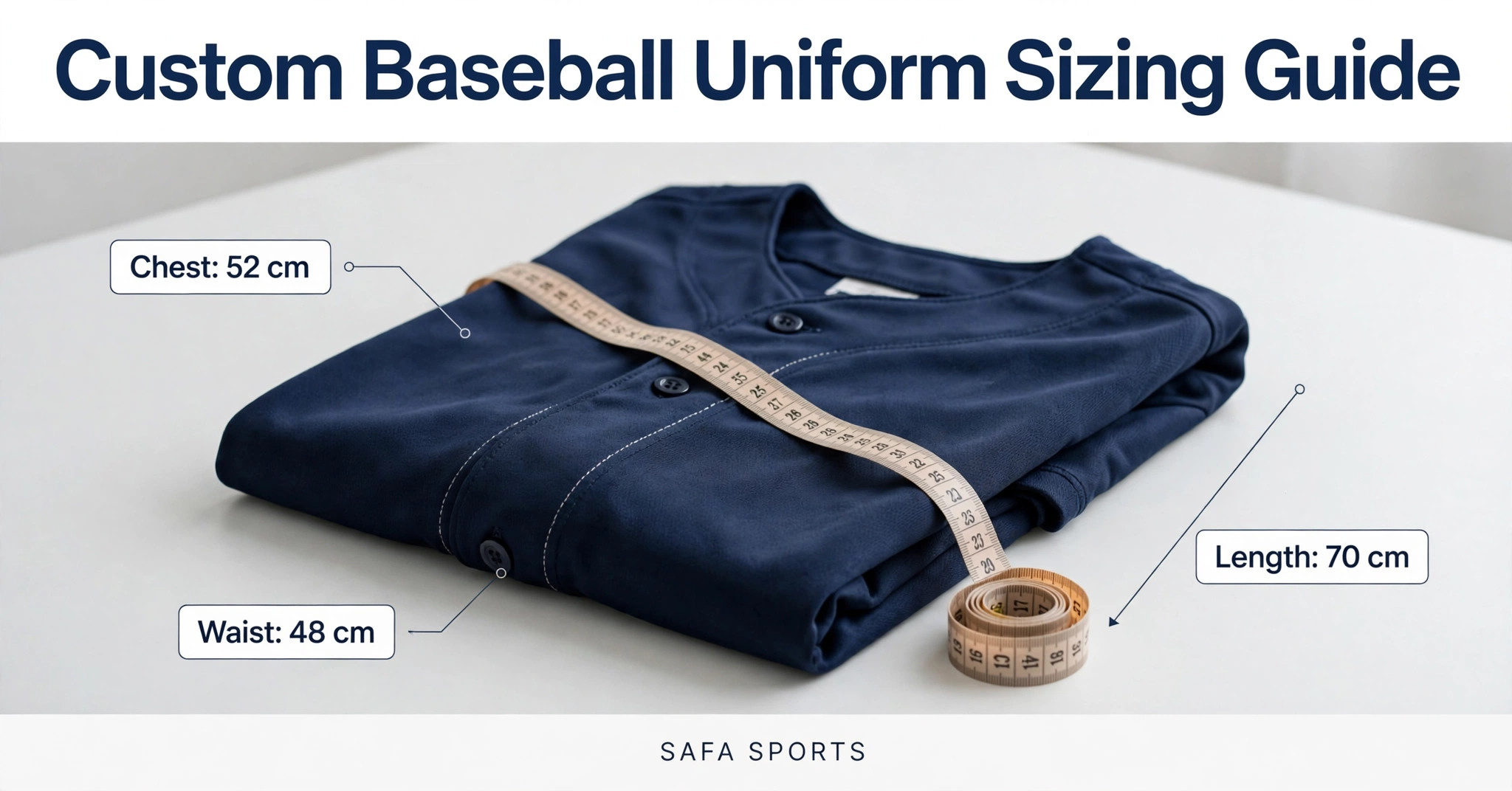
Custom Baseball Uniform Sizing Guide — How to Measure for a Perfect Team Fit (2026)
A custom uniform that arrives in the wrong size is worse than a late one. A late uniform can be chased; a wrong-sized one has to be remade, and a whole roster in jerseys that are too tight or pants that drag is a problem no amount of design can fix. The good news is that sizing mistakes are almost always preventable — they come from guessing instead of measuring, and from ordering as a group what should have been ordered player by player. This guide shows you how to measure for a custom baseball uniform, how to read a size chart, and how to order a full team set that fits the first time.
The direct answer
Measure four numbers for every player — chest, waist, torso length and inseam — then compare them with the size chart for the uniform you are actually ordering. Order the size that fits now, not the size a player might grow into, except for youth players, where one size up is the most you should go. If a player sits between two sizes, let the jersey size follow the chest and the pants size follow the waist. And always confirm the mockup before production: the mockup is the last chance to catch a wrong size before it is sewn into a whole team’s uniforms.
SAFA SPORTS (PVT) LTD, a custom team uniform manufacturer since 2007, builds uniforms to the sizes on your roster, with a free design mockup before you pay and a minimum order of only 10 pieces, shipping to the USA. Send the measurements with your order, check them on the mockup, and the fit is decided before production starts — not after delivery.
Why sizing goes wrong on team orders
Most team sizing errors have the same four causes. First, sizes are guessed from age instead of measured: two 11-year-olds can be very different heights and builds, and age tells you nothing about either. Second, one parent’s idea of medium is another’s — a size collected by text message, without a tape, is a guess wearing a number. Third, the roster changes after the order is placed: a player joins late, a number changes, and the size breakdown no longer matches the team. Fourth, jerseys and pants are treated as one size, when they are sized differently — a player can be a youth large jersey and a youth medium pant, and ordering both as large guarantees one of them will be wrong.
The fix for all four is the same: measure every player, write the numbers down once, in one list, and send that list with the order. It takes an evening. It saves a season of wrong sizes.
The 4 measurements that matter
You need a soft measuring tape and a player standing straight, wearing a t-shirt — not a hoodie, which adds bulk and ruins the numbers. Take each measurement twice if you can, and have a second person check the tape.
| Measurement | How to take it | Common mistake |
|---|---|---|
| Chest | Around the fullest part of the chest, tape level, arms relaxed at the sides | Measuring over a hoodie, or pulling the tape tight — the jersey has to breathe for nine innings |
| Waist | Around the waist at the belly-button line, tape snug but not tight | Using trouser size from another brand — brands grade differently, so measure instead |
| Torso length | From the highest point of the shoulder to where the jersey hem should sit, usually mid-hip | Forgetting that a jersey worn untucked needs more length than one tucked in |
| Inseam | From the crotch down to the ankle bone for full-length pants; just below the knee for knickers | Measuring to the shoe instead of the ankle, which adds length the pants do not need |
Two rules cover most mistakes. First, measure over thin clothes, with the tape level — a tape that dips at the back gives a number that is too big. Second, if a measurement falls between two numbers on the chart, write down the exact number, not the size you think it means. The supplier’s chart decides the size; your job is only to give them honest numbers.
Youth vs adult sizing — and when a player sits between sizes
Youth and adult sizes are graded differently, and the changeover usually happens around age 13 or 14. Youth sizes run by age and waist; adult sizes run by chest and waist, with a longer inseam. A tall 13-year-old may need an adult small for length even when the youth waist still fits, and a stocky 11-year-old may need a youth large waist with a shorter inseam. When age, height and waist point to different sizes, trust the waist first for pants and the chest first for jerseys, then the inseam.
For a player between sizes, the answer depends on the garment. For a jersey, size up: a slightly roomy jersey still looks fine and plays fine, while a tight one restricts a swing. For pants, size by the waist and adjust the length — a waist that is too tight stops a player running, and a hem that drags wears through in weeks. Our guide to Custom Youth Baseball Pants: Sizing, Styles and Ordering Guide covers waist-first sizing and when to size up in detail.
For growing youth players, one size up is the most you should go — and only for pull-on, elastic-bottom or adjustable pants, which hide extra length. Do not size up open-bottom pants: the hem drags, gets wet and wears through. A whole team sized up looks sloppy and trips more. Order the size that fits now, and budget for a new set next season.
Jersey fit styles — classic, athletic, relaxed
The same chest measurement can be cut three ways, and the fit style changes how the jersey feels as much as the size does. Tell your supplier which fit you want when you order — it is chosen at the mockup stage, not after.
| Fit style | How it sits | Best for |
|---|---|---|
| Classic | Straight cut, room to move, jersey sits away from the body | Most teams — the safe default, comfortable for every position |
| Athletic | Tapered at the waist, closer to the body, less excess fabric | Older players and travel teams who want a sharp, fitted look |
| Relaxed | Extra room through the chest and body, longer hem | Youth teams, hot weather, and players who layer underneath |
A classic fit forgives a measurement that is slightly off; an athletic fit does not. If you are unsure, order classic. And remember that fabric changes how a fit feels: a polyester jersey with a little stretch moves with the player, while a stiff fabric makes any fit feel tighter than it is.
Pants fit — the short version
Pants are sized by the waist, not by age — the same rule as jerseys, applied to a different number. Knicker-style pants end just below the knee and suit the traditional look; full-length pants reach the shoe and protect the legs when sliding. An elastic waist is easiest for younger players; a belted waist with a zip fly looks sharper for older ones. Pick one style for the whole roster — mixed styles look untidy in team photos — and size each player by the waist first, then the inseam. The full comparison, including which style suits which age, is in our youth baseball pants guide.
Team ordering checklist
Use this before you send the order, and the sizes will take care of themselves:
- Collect measurements early. One evening, one tape, every player — chest, waist, torso length, inseam — in a single list, with names spelled correctly and numbers checked with parents.
- Mix youth and adult sizes freely. Youth and adult sizes can be mixed in a single order, so a team with 12-year-olds and 14-year-olds is no problem — just give the size breakdown per player.
- Add one or two spares. One spare jersey and one spare pair of pants in the most common size saves a season when a player tears a knee or outgrows a pair mid-season.
- Confirm the mockup. Check every name, number and size on the free mockup before production. SAFA SPORTS gives the mockup before you pay — use it.
- Get the delivery date in writing. Sizes are only half the order; the other half is time. Our guide to how long custom baseball uniforms take explains how to work backwards from your first game, so the right sizes arrive on the right day.
- Keep the list. Save the roster with sizes for next season. Reordering the same sizes is fast — and a record stops the whole measuring evening from happening again.
Frequently asked questions
What if a player is between sizes?
For a jersey, size up — a roomy jersey plays fine, a tight one does not. For pants, size by the waist first; if the waist fits but the inseam is long, ask about a shorter inseam or an adjustable style rather than sizing the waist down.
Do custom uniforms shrink?
Polyester barely shrinks at all, which is one reason it is the standard for game uniforms. Cotton can shrink in hot water and in the dryer. Either way, wash cold and air dry — our washing guide explains the routine that keeps sizes true all season.
Can I reorder one size later?
Usually yes, if the supplier still holds your design — but a single-piece reorder may not meet the minimum order, which at SAFA SPORTS is 10 pieces. That is why spares in the most common sizes are worth adding to the first order.
The bottom line
Sizing is not guesswork: four measurements, one honest list, the size that fits now, and a mockup checked before production. Get those right and the uniforms fit on opening day — and nobody on the team is thinking about their jersey instead of the game.