


Sublimation vs Embroidery for Baseball Uniforms — Which Lasts Longer? (2026)
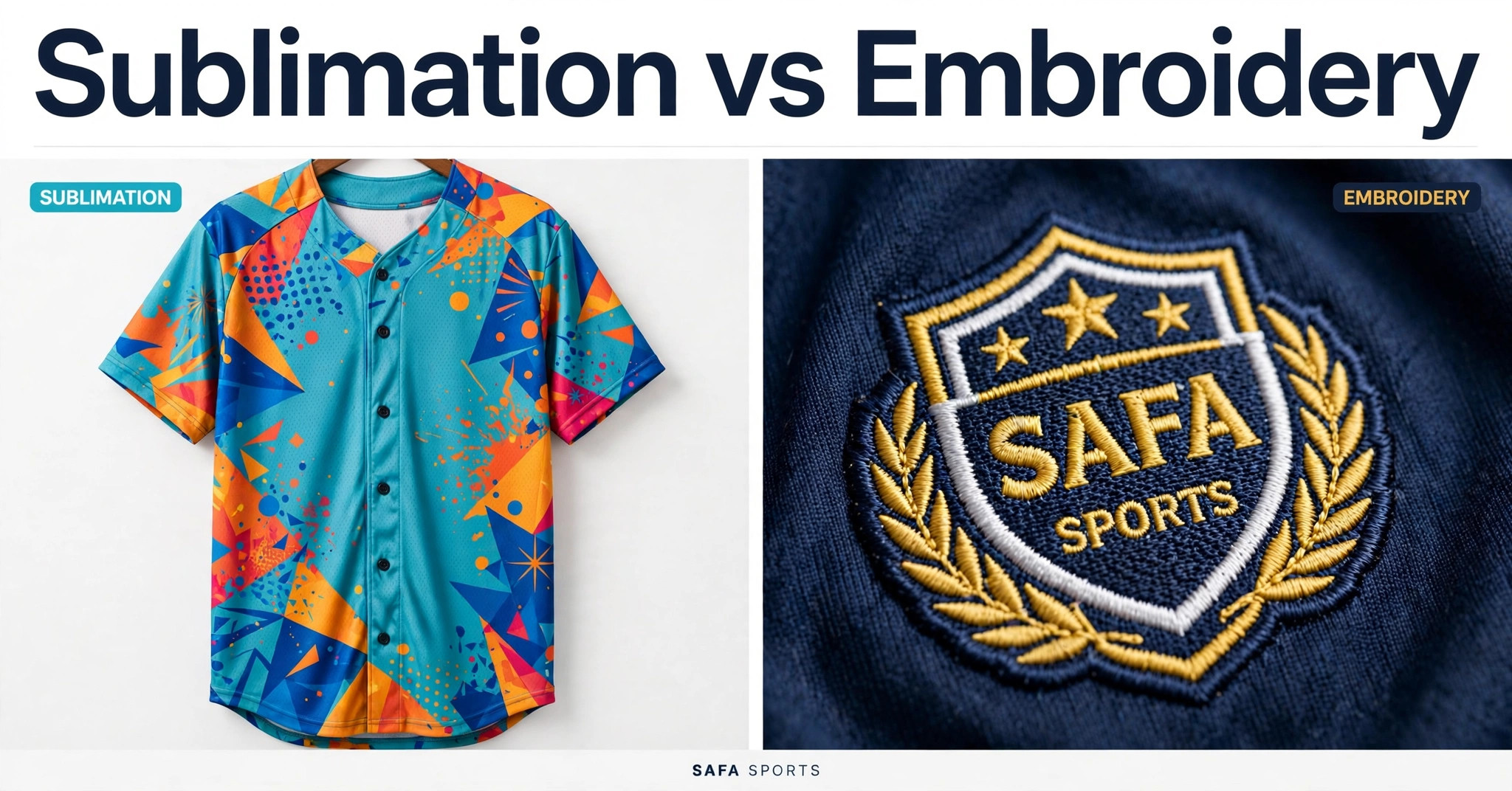
There are two ways to put a design on a baseball uniform, and they behave very differently over a season. Sublimation prints the design into the fabric itself, in full colour, with nothing to feel on the surface. Embroidery stitches it on in thread, raised and textured, with a premium look you can feel with your fingers. Both last — but they last in different ways, cost different amounts, and suit different parts of the uniform. This guide compares them head to head, so you can choose the right method for your team instead of paying for the wrong one.
The direct answer
For most teams, the answer is both: sublimation for the jersey body, names and numbers, and embroidery for the chest logo and the cap. Sublimation gives you unlimited colour, gradients and all-over designs that never crack or peel, because the dye is bonded into the fibre. Embroidery gives you the longest-lasting decoration of all — thread does not crack, peel or fade the way print can — and it looks premium on small logos. If you must pick one, pick sublimation when the design is the point — a full custom look with patterns and side panels — and pick embroidery when the logo is the point and the design is small and simple.
SAFA SPORTS (PVT) LTD, a custom team uniform manufacturer since 2007, offers both methods, with a free design mockup before you pay and a minimum order of only 10 pieces, shipping to the USA. Ask to see both options on your own design in the mockup — the difference is obvious the moment you see them side by side.
What sublimation is
Sublimation — full-dye sublimation — prints the design onto the fabric and then bonds the dye into the fibre itself with heat. The colour is not sitting on top of the fabric; it is part of it. That is why a sublimated jersey can carry gradients, patterns, photographs and all-over print in any number of colours, and why names and numbers are included in the print rather than added afterwards. Run your hand over a sublimated jersey and you feel nothing but fabric.
There is one hard limit: sublimation only works on polyester. The dye needs polyester fibre to bond with, so a cotton jersey cannot be sublimated at all. That is why the fabric you choose decides the decoration method as much as the design does — 100% polyester is the standard for a sublimated uniform, and it is also the fabric that wicks sweat and dries fast. Sublimation also takes the longest in production: typically 15 to 25 business days, because the uniform is printed and built from scratch. Our guide to how long custom baseball uniforms take explains where that time goes.
What embroidery is
Embroidery stitches the design into the fabric with thread. A logo is first digitised — turned into a stitch file that tells the machine where every stitch goes — and then sewn, layer by layer, into a raised design you can feel. The result looks premium: a chest logo in thread reads as more expensive than the same logo printed, which is why caps, polos and jackets are usually embroidered.
The limits are detail and scale. Fine lines, tiny text and gradients do not stitch well — thread comes in fixed colours, so a design with twenty shades becomes a design with a handful of thread colours. Large designs get heavy and stiff, and take a long time to sew, so embroidery suits small marks: a chest logo, a cap, a sleeve patch. Like sublimation, it needs time: the logo must be digitised first, and stitching runs slower than printing — typically 14 to 21 days for production.
Head to head
| Factor | Sublimation | Embroidery |
|---|---|---|
| Durability after washing | Colours are bonded into the fibre — never cracks or peels; fades only with harsh, hot washing | Thread does not crack, peel or fade — the longest-lasting decoration; can snag on velcro or rough surfaces |
| Colour range | Unlimited — gradients, patterns, photos, any number of colours | Fixed thread colours — no gradients, fine detail is lost |
| Feel and comfort | No feel at all — the jersey feels like plain fabric | Raised and slightly stiffer where stitched; a large embroidered area can feel heavy |
| Best placement | Full jersey graphics, names and numbers, side panels, all-over print | Chest logo, cap, sleeve patch, small marks |
| Cost | Suits complex multi-colour art — the cost is spread across the whole garment | Usually costs more per logo, plus a one-off digitising step for the stitch file |
| Production time | Longest — typically 15 to 25 business days | Digitising plus stitching — typically 14 to 21 days |
Neither method is simply “better”. Sublimation wins on colour and coverage; embroidery wins on longevity and the premium look. The teams that get the most from their money use both, each where it is strongest.
Which to pick — youth teams vs adult and league teams
For youth teams, sublimation is usually the right call for the jersey: it is light, it carries the full design in bright colours that young players love, and there is nothing stiff or raised to irritate the skin. Add embroidery only for the cap or a small chest logo, if the budget allows — it is the detail parents notice in photos.
For adult, league and travel teams, combine them. A sublimated jersey body with an embroidered chest logo is the standard premium look: the design is full-colour where it should be, and the logo has the raised, stitched finish that reads as a step above a printed one. If the budget only stretches to one method, choose by the logo: a small, simple logo in a few colours is made for embroidery; a large, multi-colour or all-over design belongs in sublimation.
Care notes for each method
Both methods survive the same routine, and both die the same way: heat. Wash cold, inside out, on a gentle cycle, with mild detergent and no bleach or fabric softener, then air dry — the full routine is in our washing guide. Two extras: never iron directly on a printed name, number or logo, and never iron directly on embroidery — use a pressing cloth, or turn the garment inside out. And keep embroidered pieces away from velcro in the wash, which snags thread.
With that routine, a sublimated uniform should look sharp for a full season and usually into a second. Embroidery lasts longer still — it is the decoration that survives the most washing, because thread does not crack or peel. If your numbers are cracking after five washes, the problem is almost certainly heat, not the method.
Frequently asked questions
Does sublimation crack or peel?
No. Sublimation is dye bonded into the fibre, not a layer sitting on top — there is nothing to crack or peel. What it can do is fade, slowly, if it is washed hot and dried hot season after season. Wash cold and it holds its colour.
Can you combine both on one uniform?
Yes, and most premium team sets do exactly that: a sublimated jersey body with an embroidered chest logo, and often an embroidered cap to match. Tell your supplier you want both when you ask for the mockup, so the two methods are designed to sit together.
Which method is better for a team logo?
For a small chest logo in a few colours, embroidery — it looks premium and lasts longest. For a large logo, a multi-colour design, or a logo that is part of an all-over print, sublimation — embroidery cannot carry that much detail, and a large stitched area feels heavy.
The bottom line
Sublimation for colour and coverage, embroidery for the logo and the premium finish — and both together when the budget allows. Pick the method that fits the design, not the other way round, and ask to see both on your own mockup before you pay. The right choice is the one that still looks new in September.