


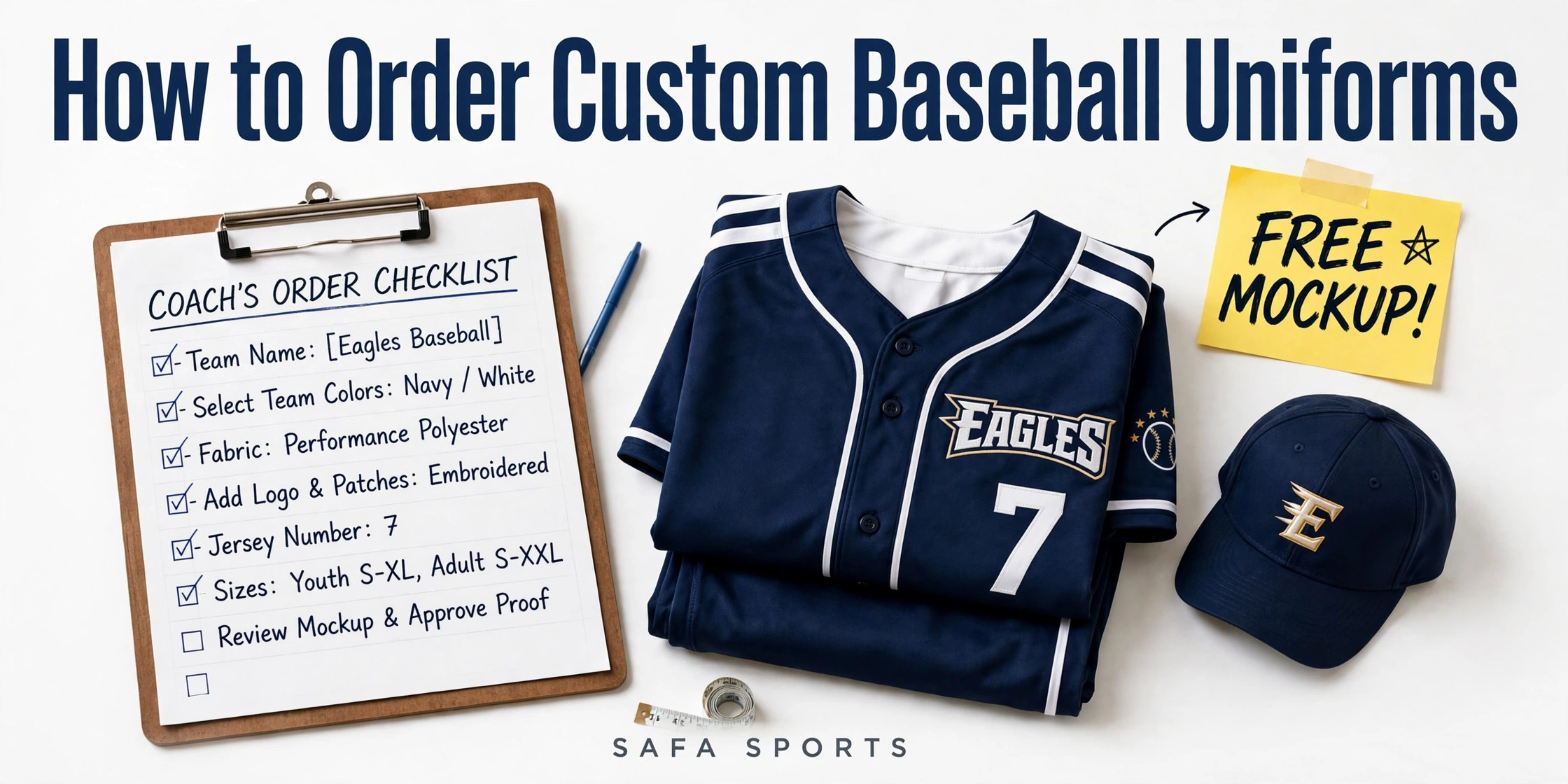
How to Order Custom Baseball Uniforms: A Step-by-Step Guide for Teams (2026)
Ordering custom baseball uniforms for the first time feels bigger than it is. A coach or team manager is spending the team’s money, choosing sizes for a whole roster, and trusting a manufacturer they have never met with the team’s name on the chest. The process itself, though, is straightforward — and most of the mistakes first-time buyers make happen before the order is even placed, in the decisions that were skipped or guessed at. This guide walks through the whole ordering process, step by step, so that by the end of it you know exactly what to send, what to check, and what happens next.
The direct answer
Ordering custom baseball uniforms takes seven steps: decide the team name, colours and quantity; send your logo and your names-and-numbers list; approve the free design mockup; confirm the size breakdown; pay for the order; wait for production and shipping; and check the box when it arrives. The two steps that matter most are the ones buyers rush — the mockup check and the size list. Get those right and almost nothing else can go wrong.
SAFA SPORTS (PVT) LTD, a custom team uniform manufacturer since 2007, builds uniforms with a free design mockup before you pay and a minimum order of only 10 pieces, shipping to the USA. The steps below are written around that process, but they apply to any custom uniform order.
Step 1: Decide the basics before you order
Before you talk to any supplier, settle four things. First, the team name exactly as it should appear on the jersey — including capitalisation, because “Eagles” and “EAGLES” are different designs. Second, your colours: one main colour and one contrast colour is enough for most teams, and it keeps the design readable from the stands. Third, the quantity: how many players, plus spares — more on spares below. Fourth, what the set includes: jersey and pants, or the full set with socks and cap as well.
It also helps to know the age group and league before you order. Youth teams and adult teams are sized differently, and a youth league may have its own rules about numbers or logos. If your league has a uniform rulebook, read it before the mockup is made — changing a design after approval costs time that a season schedule does not have.
Step 2: Send your design — or send nothing at all
To start a design you need surprisingly little: your logo file, your colours, and your names-and-numbers list. The logo file is best as a PNG or vector file, but a clear photo of an existing logo is enough to start from — the supplier redraws it for the mockup. Along with the logo, send the team name, the colour codes if you have them (a photo of last season’s jersey works too), and the list of player names and numbers, spelled exactly as they should appear.
If you have no logo yet, that is not a problem — it is the most common situation for a new team. Send the team name and colours, and the supplier’s design team will propose a logo and a jersey layout in the mockup. Our guide to how to design a baseball uniform explains how to pick colours, lettering and logo placement before the mockup is drawn, so you can arrive with a clear idea instead of a blank page.
Two warnings at this stage. First, send names and numbers in a single typed list — a spreadsheet or a document, not a string of text messages. Names collected by text message are where spelling mistakes are born. Second, confirm every number with the player or parent: a wrong number on a jersey is a problem for the whole season, and it is avoidable in five minutes.
Step 3: The free design mockup — your last free chance to fix anything
The mockup is a picture of your finished uniform, made before production starts. It shows the jersey front and back, the pants, the colours, the logo, every name and every number. At SAFA SPORTS it is free, and it comes before you pay — so it is the single most valuable step in the whole order.
Check the mockup slowly, name by name. Read every name out loud against your list, check every number, and check the colours against the team colours you sent — not against your memory of them. Look at the spelling of the team name, the placement of the logo, and whether the numbers are readable from a distance. Ask the supplier to change anything that is wrong, and ask for a fresh mockup after the change — do not approve a correction you have not seen.
A common mistake is to approve the mockup on a phone screen at speed. Open it on a bigger screen, print it if you can, and have a second person check it. The mockup is free to change; the finished uniforms are not.
Step 4: Confirm the sizes
Sizes are decided from measurements, not from age or from last season’s sizes. For every player you need the chest, waist, torso length and inseam — and if you have not measured the team yet, do it now, before the mockup is approved, because a size change after approval can delay the order.
Our custom baseball uniform sizing guide explains how to take all four measurements and how to read the size chart, including what to do when a player sits between two sizes. Youth and adult sizes can be mixed in a single order, so a team with 12-year-olds and 14-year-olds is no problem — just give the size breakdown player by player. And if you are ordering youth pants, our youth baseball pants guide covers waist-first sizing and which style suits which age.
Send the size list with the order, in the same document as the names and numbers, so that nothing is split across messages. One list, one place, checked once.
Step 5: MOQ 10 — and why to order spares
At SAFA SPORTS the minimum order is 10 pieces, which is low enough for a small team, a youth squad or a first order. But ordering exactly the number of players is a mistake most teams make once. Players get injured, a new player joins mid-season, a jersey tears on a slide — and a single-piece reorder later may not meet the minimum order, which means waiting until you can justify a full batch.
Add one or two spares in the most common size — one spare jersey and one spare pair of pants. They cost little now and save a season later. If your roster is 12 players, order 13 or 14 pieces. The spares are blank or carry a spare number, and they sit in the kit bag until they are needed.
Step 6: Production and shipping, in plain terms
Once the mockup is approved and the order is paid, production starts: fabric is cut, the design is printed or embroidered, and the uniforms are sewn and checked. How long that takes depends on the order — quantity, design complexity and the time of year all matter, and a supplier who gives you a date in writing is worth more than one who gives you a fast verbal promise.
Work backwards from your first game, not forwards from today. Decide the date the uniforms must be in hand, then ask the supplier for the production and shipping time and count back from there. Our guide to how long custom baseball uniforms take explains how to do that calculation, and what to do if the season starts sooner than the standard timeline allows.
One point worth settling before you pay: ask what the shipping covers, and who to contact if the delivery is delayed. A supplier who answers that plainly before the order is one who will answer it after the order too.
Step 7: What to check when the box arrives
When the uniforms arrive, do not hand them out straight away. Open the box and check four things. First, count them — every piece, against the order. Second, check the sizes against your list, player by player. Third, check the print and stitching: names spelled right, numbers in the right place, colours as approved on the mockup. Fourth, try one jersey and one pair of pants on before the whole team dresses in them — a fit problem caught on one player is a quick fix; caught on a whole roster, it is a delay.
If something is wrong, photograph it and contact the supplier the same day, with the mockup beside it. A clear photo and the approved mockup settle most disputes in one message.
The ordering checklist
Keep this list beside you when you place the order:
- Team name, colours and quantity decided — main colour, contrast colour, jersey + pants or full set.
- Logo file sent — or a clear brief for a new logo, with the team name and colours.
- Names and numbers in one typed list — spelled correctly, numbers confirmed with players.
- Mockup checked slowly — every name, every number, colours and logo placement, on a big screen, by two people.
- Sizes measured and sent — chest, waist, torso length, inseam, per player; see the sizing guide.
- Spares added — one or two in the most common size.
- Delivery date in writing — counted back from your first game; see the timeline guide.
- Box checked on arrival — count, sizes, print quality, one trial fit before handing them out.
Frequently asked questions
Can I order just 10 uniforms?
Yes. At SAFA SPORTS the minimum order is 10 pieces, so a small team or a first order is fine. Just remember the spares — ordering 10 for 10 players leaves nothing for injuries or new joiners, so most teams order 11 or 12.
Can I reorder the same design later?
Usually yes, if the supplier still holds your design and artwork. Keep the mockup and the order details — the file names, the colours, the size breakdown — so the reorder is a repeat, not a redesign. If you are planning to reorder, say so when you place the first order, so the design is filed properly. And remember that a single-piece reorder may not meet the minimum order on its own.
What if a name is spelled wrong on the mockup?
Tell the supplier before you approve it. The mockup is free to change, and a corrected mockup should be sent back for a fresh check. Never approve a mockup with a mistake in it on the promise that it will be fixed in production — the mockup is the record of what was agreed. If a mistake is only spotted after delivery, photograph it next to the approved mockup and contact the supplier the same day.
Do I need to know about fabric before I order?
Not in detail — but it helps to know the basics, because fabric decides how the uniform feels in a summer game. Our guide to the best fabric for custom baseball uniforms compares polyester and cotton, and explains why polyester is the standard for game uniforms. If you have a preference, say so when you send the design.
How much will the uniforms cost?
It depends on quantity, fabric and design complexity, and the honest answer is to ask for a quote with your exact numbers. Our guide to how much custom baseball uniforms cost in 2026 explains what drives the price and how to budget for a small team, so you know what to expect before the quote arrives.
The bottom line
Ordering custom baseball uniforms is seven steps, and only two of them decide whether the order goes right: the mockup check and the size list. Decide the basics, send one clean list of names, numbers and sizes, check the free mockup slowly with a second pair of eyes, add a spare or two, and check the box when it arrives. Do that, and the uniforms fit on opening day — and the only thing left to worry about is the game.