


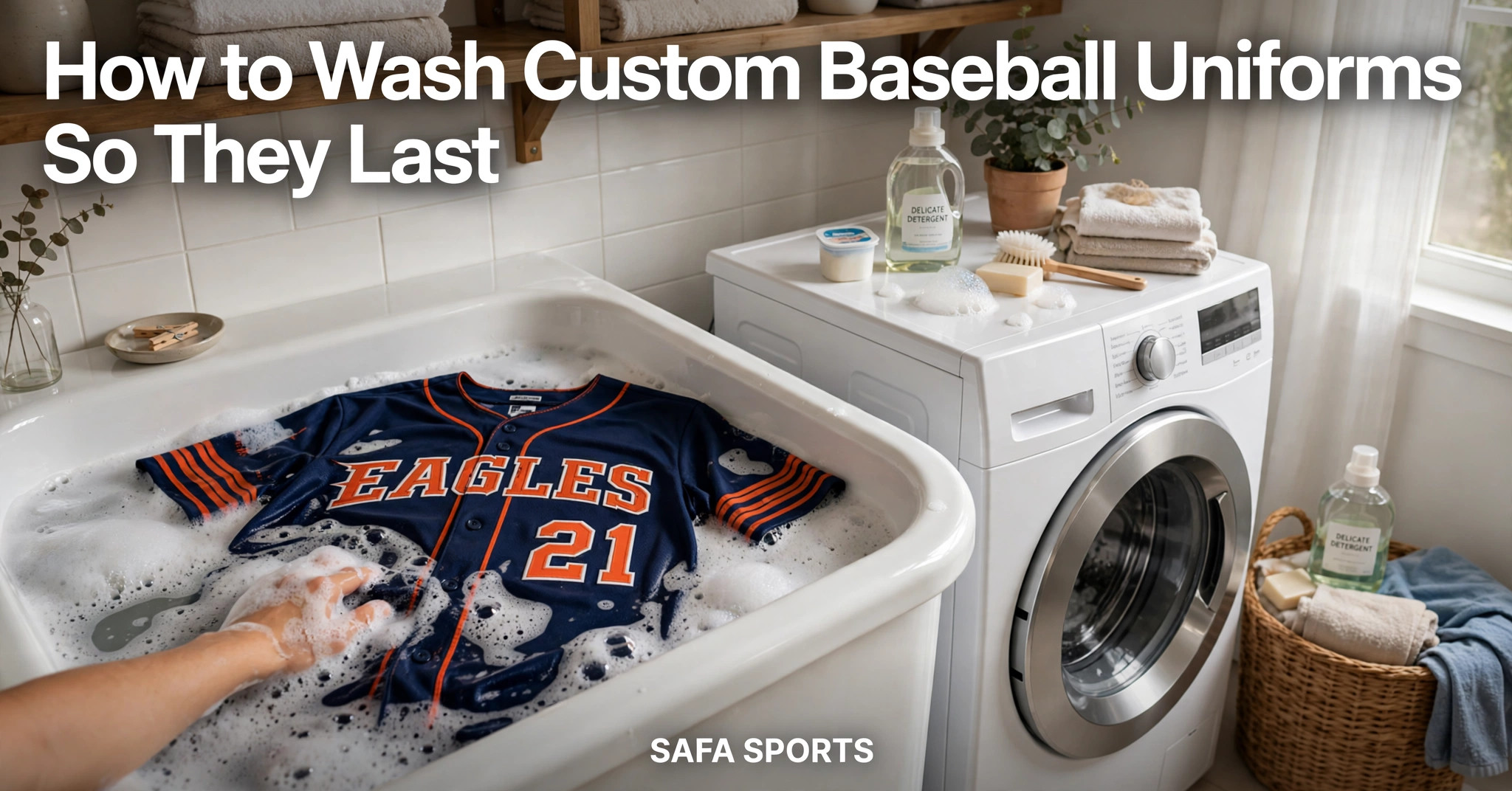
How to Wash Custom Baseball Uniforms So They Last
A custom uniform is an investment — your team paid for the design, the names, the numbers and the print. Most uniforms do not die on the field. They die in the laundry: hot water, harsh detergent, bleach, and a hot dryer, repeated twenty times a season, until the numbers crack, the colours fade and the jersey looks two years older than it is. The good news is that the fix is simple, and it costs nothing. This guide shows you how to wash custom baseball uniforms so they last the whole season — and the next one.
The direct answer
Wash custom baseball uniforms in cold water, inside out, on a gentle cycle, with mild detergent and no bleach or fabric softener — then air dry them, never tumble dry on high heat. That one routine protects sublimated prints, screen printing, heat-transfer vinyl and embroidery alike. Hot water and a hot dryer are the two fastest ways to ruin a uniform: heat cracks vinyl and transfer prints, fades sublimation, shrinks cotton, and sets grass and clay stains permanently.
SAFA SPORTS (PVT) LTD, a custom team uniform manufacturer since 2007, builds uniforms to survive a season of real play, with a free design mockup before you pay and a minimum order of only 10 pieces, shipping to the USA. But even the best-made uniform needs the right wash. Follow the routine below and your uniforms will look new far longer.
Before the wash: five minutes that save the uniform
- Turn everything inside out. Names, numbers and logos face inward, so they rub against each other instead of against the drum and other clothes. This one step does more than anything else to stop cracking and peeling.
- Pre-treat stains right away. Grass, red clay and dirt set fast. Rinse the stain under cold water first — never hot, which sets protein stains — then dab (do not scrub) a little mild detergent or a stain remover on it and leave it for 10 to 15 minutes before washing.
- Empty the pockets and close the zippers. Loose items scratch prints, and open zippers snag mesh and embroidery.
- Wash uniforms together, alone. Do not wash them with jeans, towels or anything with velcro or rough zippers. Heavy items abrade prints and pull at stitching.
- Do not let a dirty uniform sit. A sweaty uniform left in a kit bag for two days grows mildew and locks in odour. If you cannot wash it the same night, at least hang it up to air out.
The wash: cold, gentle, mild
| Step | Do this | Why |
|---|---|---|
| Water temperature | Cold (30°C / 85°F or below) | Hot water fades colour, shrinks cotton, and sets stains |
| Cycle | Gentle or delicates | Less agitation means less cracking and less pilling |
| Detergent | Mild liquid detergent, normal dose | Harsh powders and pods with bleach damage prints |
| Bleach | Never — not even “colour-safe” bleach on printed areas | Bleach attacks sublimation dye and vinyl |
| Fabric softener | Never | Softener coats the fibres, traps odour, and loosens heat-transfer vinyl |
| Extra rinse | Yes, if your machine offers it | Removes detergent residue that dulls colours |
A note on detergent: if your team plays on red clay fields, a detergent with an oxygen-based stain booster (not chlorine bleach) helps with the orange tint without attacking the print. Test it on one old practice shirt first.
Drying: the step most teams get wrong
Air drying is the single best thing you can do for a custom uniform. Hang jerseys and pants on a hanger or a drying rack, out of direct sunlight — strong sun fades colours over a season. Most polyester uniforms dry in a few hours indoors with a little airflow.
If you must use a dryer, use the lowest heat setting, or air-fluff with no heat, and take the uniform out while it is still slightly damp. High heat is what cracks heat-transfer numbers, melts vinyl edges, and shrinks cotton blends. Never iron directly on a printed name, number or logo: if a jersey needs pressing, turn it inside out and iron on low, or use a pressing cloth between the iron and the print.
Stains: what works on what
- Grass stains: cold rinse, then mild detergent or white vinegar dabbed on the stain, 15 minutes, then a cold wash. Grass is a dye stain, so speed matters more than strength.
- Red clay: let the mud dry completely first, brush off the loose dirt, then soak in cold water with a little detergent for 30 minutes before washing. Washing wet clay in just spreads it.
- Blood: cold water only, immediately. Hot water sets blood permanently.
- Sweat and odour: a cup of white vinegar in the rinse cycle, or a sports-specific detergent, breaks down the bacteria that cause the smell. Fabric softener does the opposite — it traps odour in the fibres.
- Gum or pine tar: freeze the spot with ice, peel off what you can, then dab with a little rubbing alcohol on a cloth before washing.
How long should a uniform last?
With this routine, a quality polyester sublimated uniform should look sharp for a full season of twice-weekly play and washing, and usually into a second season. Screen-printed and vinyl numbers wear faster — expect some cracking after 20 to 30 washes even with perfect care, which is normal for those methods, not a defect. Embroidery lasts longest of all, because thread does not crack or peel; it is the decoration that survives the most washing.
If your numbers are cracking after five washes, the problem is almost certainly heat — a hot wash, a hot dryer, or ironing directly on the print. Fix the routine first, and only then question the printing.
A simple routine for the whole team
Print this and put it in the dugout or the team group chat: cold water, inside out, gentle cycle, mild detergent, no bleach, no softener, air dry. It takes no extra time and no extra money — just the discipline to do it the same way every time. The uniforms your team wears in September should look like the ones they wore in April, and with the right wash, they will.