


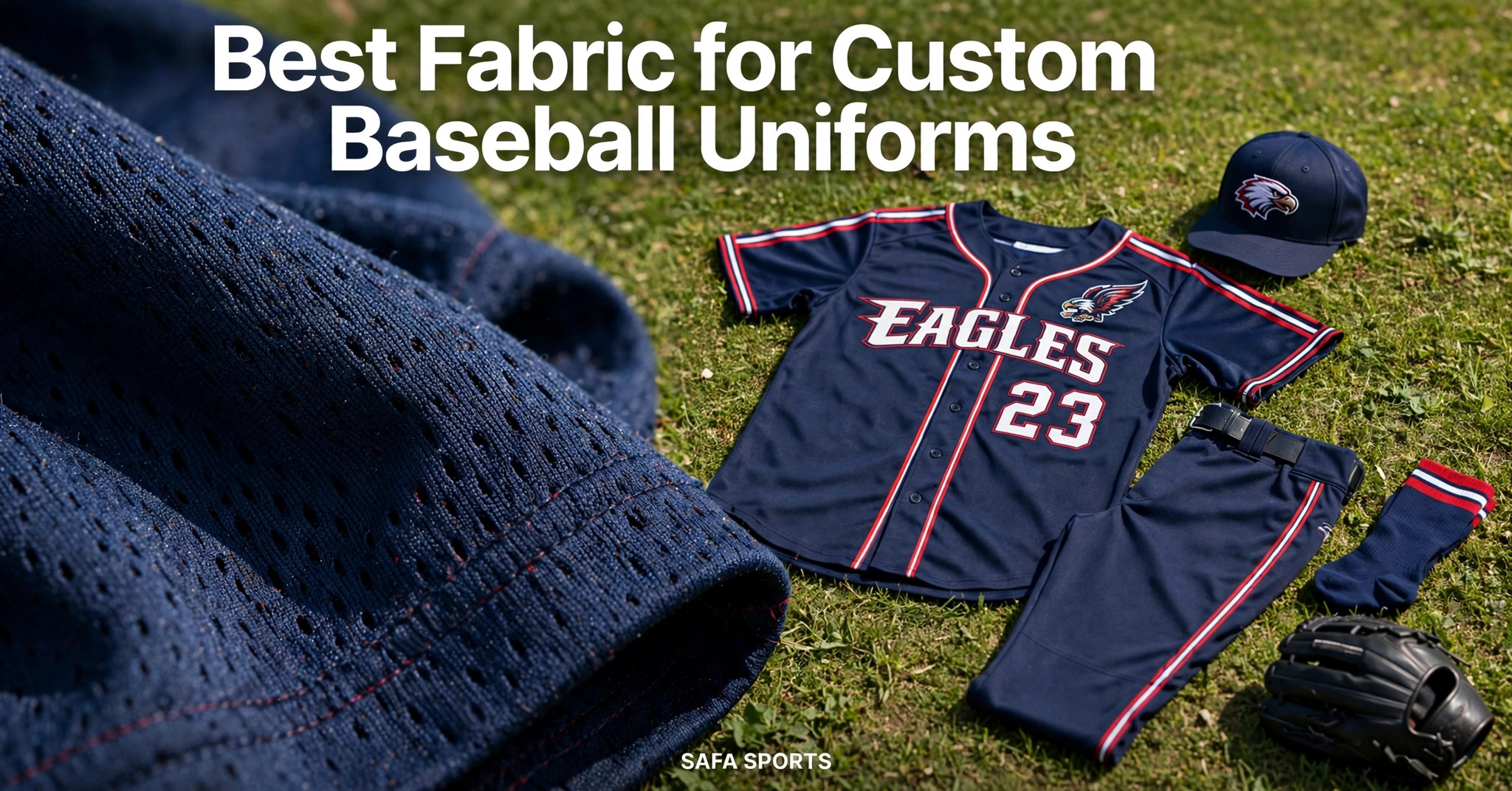
Best Fabric for Custom Baseball Uniforms: Polyester vs Cotton (2026)
The fabric decides how a baseball uniform feels in the seventh inning, how it survives a season of sliding, and whether your design prints cleanly or fades after five washes. Yet most teams pick fabric last — after the design, after the price — and then wonder why the jerseys feel heavy, shrink, or lose their colour. This guide compares the fabrics that actually go into custom baseball uniforms, so you can choose with confidence before you order.
The direct answer
For most teams, the best fabric for a custom baseball uniform is 100% polyester, or a polyester-dominant blend. Polyester wicks sweat away from the skin, dries fast, holds its shape, resists shrinking, and takes full-dye sublimation printing better than any other fabric — which is why almost every professional and college uniform is polyester. Cotton feels softer and more natural at first touch, but it absorbs sweat, gets heavy, dries slowly, and is a poor match for sublimated designs. A polyester-cotton blend sits in between: softer than pure polyester, tougher and quicker-drying than pure cotton.
SAFA SPORTS (PVT) LTD, a custom team uniform manufacturer since 2007, builds uniforms in the fabric that fits your design and your budget, with a free design mockup before you pay and a minimum order of only 10 pieces, shipping to the USA. If you are unsure which fabric suits your team, ask for a fabric recommendation with your quote — and tell the supplier how you play, how often you wash, and whether your design needs sublimation.
Polyester: the standard for a reason
Polyester is a synthetic fibre, and for sport it has four advantages that matter every game. First, it wicks moisture: sweat moves through the fabric and evaporates instead of soaking in, so the jersey stays light even in August heat. Second, it dries fast — a polyester jersey hung up after a game is usually dry by the next morning. Third, it holds its shape and colour: it resists shrinking, stretching and fading through a season of washing. Fourth, it is the only fabric that takes full-dye sublimation properly, because the dye bonds with the polyester fibre itself instead of sitting on top of it.
The trade-off is feel. Cheap, stiff polyester can feel plasticky and trap heat if the weave is tight and the fabric is heavy. Good uniform polyester is different: it is knitted, often with mesh panels under the arms and across the back, and it is light — typically 160 to 200 GSM for a jersey. Ask your supplier for the GSM (grams per square metre) of the fabric they plan to use. A lower GSM means a lighter jersey; a higher GSM means a heavier, more durable one. For youth players, lighter is usually better.
Cotton: comfortable, but wrong for most games
Cotton is soft, breathable and familiar — the fabric of a favourite t-shirt. On a baseball field it has real weaknesses. Cotton absorbs sweat instead of wicking it, so a cotton jersey gets heavy as the game goes on and stays damp long after. It shrinks in hot water and in the dryer, which is a problem when a whole roster’s jerseys need to match. And it does not take sublimation at all: sublimated ink needs polyester fibre to bond with, so a cotton jersey can only be decorated with screen printing, heat transfer or embroidery — which limits your design and adds cost.
Cotton still has a place. For a casual fan jersey, a throwback design, or a team that plays rarely and values softness over performance, a cotton or cotton-rich jersey is fine. For a team that plays twice a week in summer heat, it is the wrong choice.
Polyester-cotton blends: the middle ground
A blend — typically 65% polyester and 35% cotton, or 50/50 — tries to take the best of both. It feels softer and more natural than pure polyester, dries faster and holds its shape better than pure cotton, and it is cheaper than performance polyester. The compromise is real on both sides: it wicks less well than pure polyester, and it still cannot take full sublimation — only the polyester part of the fibre takes the dye, so sublimated colours come out paler and less sharp. Blends suit screen-printed or embroidered designs, and teams that want a softer feel without giving up durability entirely.
Fabric comparison at a glance
| Fabric | Sweat handling | Drying speed | Shrinking | Sublimation | Best for |
|---|---|---|---|---|---|
| 100% polyester | Wicks well | Fast | Almost none | Excellent — full colour | Most teams, full custom designs |
| Polyester mesh | Wicks well, breathes best | Fastest | Almost none | Excellent | Hot climates, pitchers and catchers |
| Cotton | Absorbs, gets heavy | Slow | Yes, in heat | No | Casual or throwback jerseys |
| Poly-cotton blend (65/35) | Moderate | Moderate | Slight | Poor — colours come out pale | Softer feel, printed designs |
| Performance knit (poly + spandex) | Wicks well, stretches | Fast | Almost none | Good | Fitted jerseys, players who want stretch |
What about pants?
Pants take more punishment than jerseys — sliding, diving, kneeling — so durability matters more and softness matters less. Most custom baseball pants are 100% polyester, often a heavier double-knit polyester, because it resists tearing and holds its shape after repeated washing. A small amount of spandex (2 to 5%) adds stretch for sliding and running without changing how the pants wash. Cotton pants wear out faster at the knees and fade sooner; save cotton for practice shirts, not game pants.
Five questions to ask before you order
- What is the GSM? A jersey at 160–200 GSM is light and cool; above 220 GSM it is heavy and hot. Ask for the number, not just “lightweight”.
- Is it sublimation-ready? If your design has gradients, patterns or all-over print, you need 100% polyester. A blend will wash the colours out.
- Does it have mesh panels? Mesh under the arms and on the back is the cheapest cooling upgrade there is.
- How does it wash? Polyester wants cold water and air drying (see our care guide). Cotton wants the same, but will still shrink if the dryer runs hot.
- Can I see a sample? A physical sample answers in ten seconds what a spec sheet cannot — how the fabric actually feels. SAFA SPORTS offers a free design mockup, and a sample order is the surest way to check fabric, fit and print before the bulk run.
The bottom line
If you want one rule, here it is: order 100% polyester for game uniforms, pick a lighter GSM for youth players, and add mesh panels if you play in heat. Choose a blend only when softness matters more than a full sublimated design, and choose cotton only for casual wear. The fabric is not the place to save money — it is the thing your players feel for nine innings, and it decides whether the uniform still looks new in September or faded by June.