


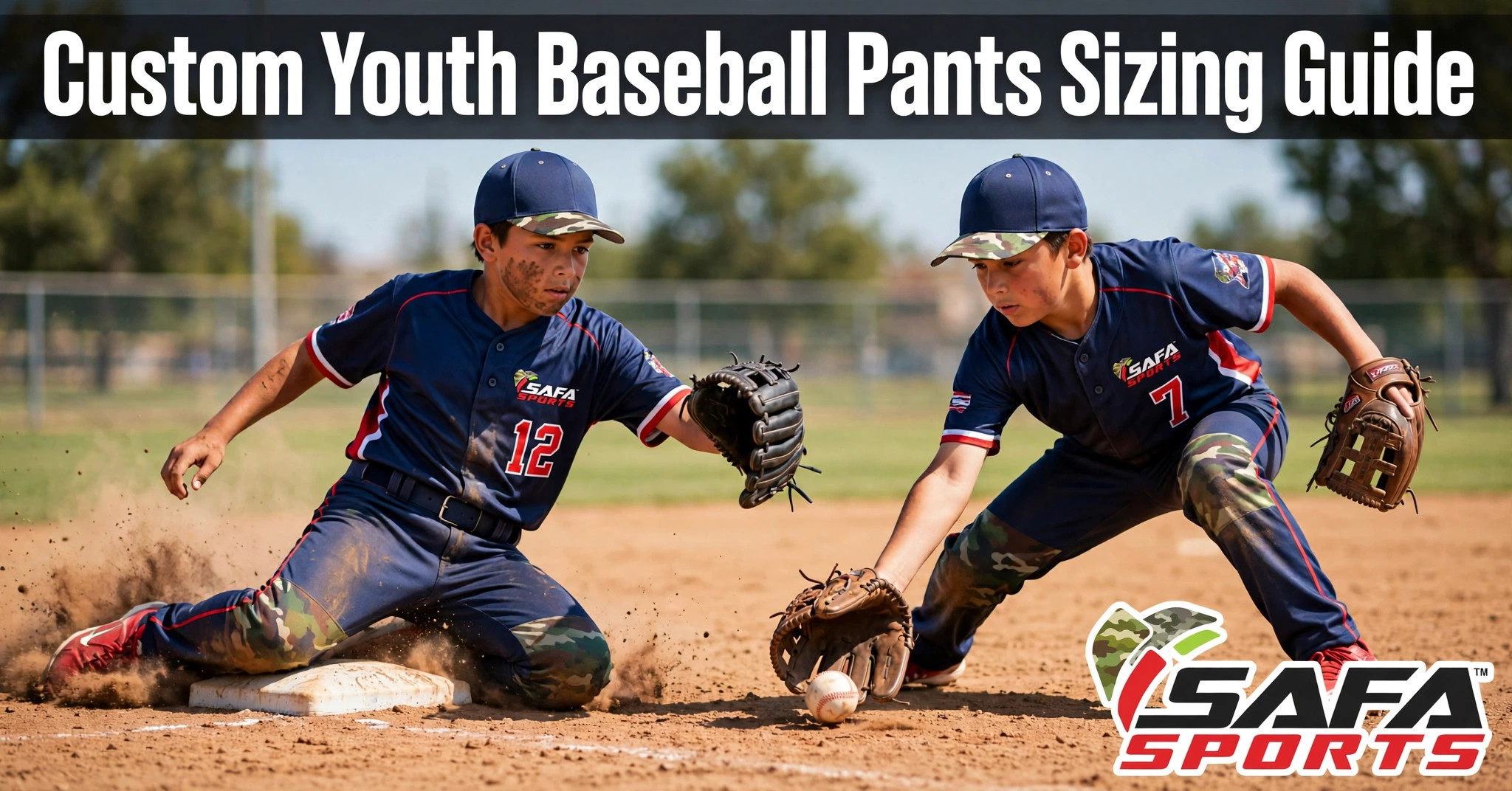
Custom Youth Baseball Pants: Sizing, Styles and Ordering Guide
Jerseys get all the attention, but pants are where a youth baseball uniform either fits or fails. A jersey that is slightly roomy still looks fine. Pants that are too long drag in the dirt, pants that are too tight stop a player running, and pants that slide down mid-game distract everyone. This guide covers how to size youth baseball pants, which style suits which age, what fabric to choose, and how to order a matching set for your team.
Youth baseball pants size chart by age
Youth baseball pants are sized by waist, not by age. Age is only a rough guide for when you cannot measure. The chart below is a general starting point used across most youth brands — always confirm against the size chart for the pants you actually order, because brands grade differently.
| Age (rough) | Youth size | Waist | Height (rough) |
|---|---|---|---|
| 4 to 6 | YXS | 20 to 22 inches | 40 to 46 inches |
| 6 to 8 | YS | 22 to 24 inches | 46 to 51 inches |
| 8 to 10 | YM | 24 to 26 inches | 51 to 56 inches |
| 10 to 12 | YL | 26 to 28 inches | 56 to 61 inches |
| 12 to 14 | YXL | 28 to 30 inches | 61 to 64 inches |
| 14 and up | Adult S | 28 to 30 inches, longer inseam | 64 inches and up |
If age, height and waist point to different sizes, trust the waist first, then the inseam. A tall 12-year-old may need an adult small for length even when the youth waist fits. A stocky 9-year-old may need a youth large waist with a shorter inseam. When in doubt between two sizes, the next section explains when to size up and when not to.
How to measure a player for baseball pants
You need two measurements, and a soft measuring tape. Measure over thin clothes, with the player standing straight.
- Waist: measure around the waist at the belly-button line, keeping the tape level and snug but not tight. Do not pull it in — the waistband has to sit there for three hours.
- Inseam: measure from the crotch down to the ankle bone for full-length pants. For knicker-style pants, stop just below the knee.
- Check a pair they already own: lay their best-fitting sweatpants flat, measure across the waist and double it, then compare that number with the size chart. This catches measuring mistakes before you order.
For a full team, collect these two numbers per player along with the jersey size. Send one list, spellings and numbers checked, the same way you would for jerseys — our guide to Custom Youth Baseball Jerseys With Names and Numbers explains how to organise a team roster so nothing gets missed.
Should you size up for growth?
Size up by one size at most, and only for pull-on, elastic-bottom or adjustable pants — those styles hide extra length and the waistband forgives a little room. Do not size up open-bottom pants: the hem drags on the ground, gets wet, and wears through in weeks. If you need two seasons from one pair, an adjustable-inseam pant is the safest choice, because it can be worn full length or knicker-style as the player grows.
For a team order, resist the urge to size every player up. A whole team in pants one size too big looks sloppy, trips more, and slides worse. Order the size that fits now, and budget for a new set next season — youth players grow too fast for a two-year pant.
Youth baseball pant styles compared
| Style | How it fits | Best ages | Pros | Cons |
|---|---|---|---|---|
| Pull-on, elastic waist | No belt or fly, stretches on | 4 to 8 | Easiest to put on, no help needed | Less of a pro look |
| Elastic bottom | Gathers at the ankle | 6 to 12 | Never drags, can show socks, stays in place sliding | Cuff can feel tight |
| Open bottom | Straight hem to the shoe | 10 and up | Classic look, full coverage | Hem drags if too long |
| Knicker | Ends just below the knee | 10 and up | Traditional baseball look, shows socks and stirrups | Needs the right inseam or it looks wrong |
| Piped or braided | Any of the above, with a side stripe | 10 and up, travel teams | Sharp team look, matches jersey trim | Slightly higher cost |
Which style for which age?
- Ages 4 to 6 (T-ball): pull-on pants with an elastic waist. Belts and flies only slow everyone down at this age, and coaches have enough to do without helping twelve children with buttons.
- Ages 7 to 8 (coach pitch): elastic-bottom pants. They sit at the ankle or can be pulled up to show socks, and they never drag.
- Ages 9 to 10 (Little League minors): players start to care how pants look. Many switch to belted pants with a zip fly at this age, and adjustable-inseam styles work well for fast growers.
- Ages 11 to 12 (Little League majors): travel and all-star teams often want piped pants with braid down the side, in team colours.
- Ages 13 to 14 (juniors): youth XL or adult small. The inseam is the deciding factor — tall teens may need adult sizes for length even if the youth waist fits.
For a team, pick one style for the whole roster. Mixed styles look untidy in team photos and on the field, and one style keeps the order simple for the factory.
Fabric: what to look for in youth baseball pants
Youth pants take more punishment than jerseys — sliding, diving, kneeling on dirt and grass, and washing after every game. Look for these things:
- Polyester with stretch: lightweight polyester with a little spandex or elastane moves with the player and wicks sweat. Pure cotton is heavier, holds sweat and dries slowly.
- Reinforced knees: double-layer or reinforced knee panels are the difference between pants that last a season and pants that tear in week three. Ask for them, especially for catchers and infielders.
- Gusseted crotch: a diamond-shaped panel at the crotch lets the legs move freely when a player stretches, crouches or slides.
- Breathable mesh venting: mesh panels behind the knees or at the sides keep young players cooler in summer tournaments.
- Stain resistance: white and grey pants show every slide. A fabric with a stain-resistant finish, or a darker team colour for pants, saves parents a lot of scrubbing.
If you are ordering a full custom set, the pants fabric should match the jersey — same polyester family, same team colours, same decoration method. Sublimation is the usual choice for a full custom set because the colours and side piping are printed into the fabric and never peel.
Ordering custom pants for a team
Ordering pants with the jerseys is simpler than ordering them separately: one design, one mockup, one delivery date, and the colours match exactly. A few practical points:
- Minimum order: at SAFA SPORTS (PVT) LTD, the minimum order is only 10 pieces, and you get a free design mockup before you pay. The company has made custom team uniforms since 2007 and ships to the USA.
- Sizes in one order: youth and adult sizes can be mixed in a single order, so a team with 12-year-olds and 14-year-olds is no problem — just give the size breakdown per player.
- Match the jersey: send the jersey design with the pants order, or order them together, so the piping, braid and colours match. A navy pant with the wrong shade of navy next to the jersey is a mistake you will see in every photo.
- Allow time: pants add a production step to the order, so confirm the delivery date in writing when you get the quote. Our guide to How Long Do Custom Baseball Uniforms Take? explains how to work backwards from your first game, and How Much Do Custom Baseball Uniforms Cost in 2026? explains what changes the price of a full set.
- Order a spare or two: one spare pair in the most common size saves a season when a player tears a knee or outgrows a pair mid-season.
Caring for custom baseball pants
- Wash inside out in cold water, and hang to dry — high dryer heat fades sublimated colours and weakens elastic over time.
- Treat dirt and grass stains the same day; dried-in clay stains are far harder to shift.
- Do not iron directly over printed numbers, piping or logos.
- Keep white pants separate from dark jerseys in the wash, or the white will pick up colour.
Parents will thank you for printing these four lines on the team handout. Pants that are cared for properly last the whole season; pants that go through a hot dryer every week do not.
Frequently asked questions
What size baseball pants does a 10-year-old wear?
Usually a youth medium, with a waist of about 24 to 26 inches. But measure the waist and inseam — two 10-year-olds can be very different heights and builds, and the waist measurement decides the size, not the age.
Are baseball pants supposed to be tight or loose?
Snug at the waist, with room to move at the thigh and knee. They should stay up when a player runs and slides, without pinching. If a player cannot crouch comfortably, the pants are too tight. If the hem drags, they are too long.
What is the difference between knickers and full-length baseball pants?
Full-length pants reach the shoe. Knickers end just below the knee and are worn with high socks or stirrups. Knickers are the traditional look and cooler in summer; full-length pants protect the legs when sliding. For youth teams, elastic-bottom full-length pants are the easiest choice.
Can I order youth baseball pants in team colours with piping?
Yes. Custom pants can be made in your team colours with side piping or braid, sublimated or dyed to match the jersey. Order them with the jerseys so the colours match exactly, and ask for the mockup to show the pants as well as the jersey.
How many pairs of baseball pants does a youth player need?
Two pairs is ideal for a team that plays twice a week — one to wear, one in the wash. One pair works if parents wash after every game, but a torn knee mid-week then means a missed game. For a team order, add one or two spare pairs in the most common sizes.
The bottom line
Size youth baseball pants by the waist, not by age. Measure twice, pick one style for the whole team, insist on reinforced knees and a little stretch, and order the pants with the jerseys so the colours match. Get those four things right and the pants stop being something anyone notices — which, for a youth uniform, is exactly the point.